
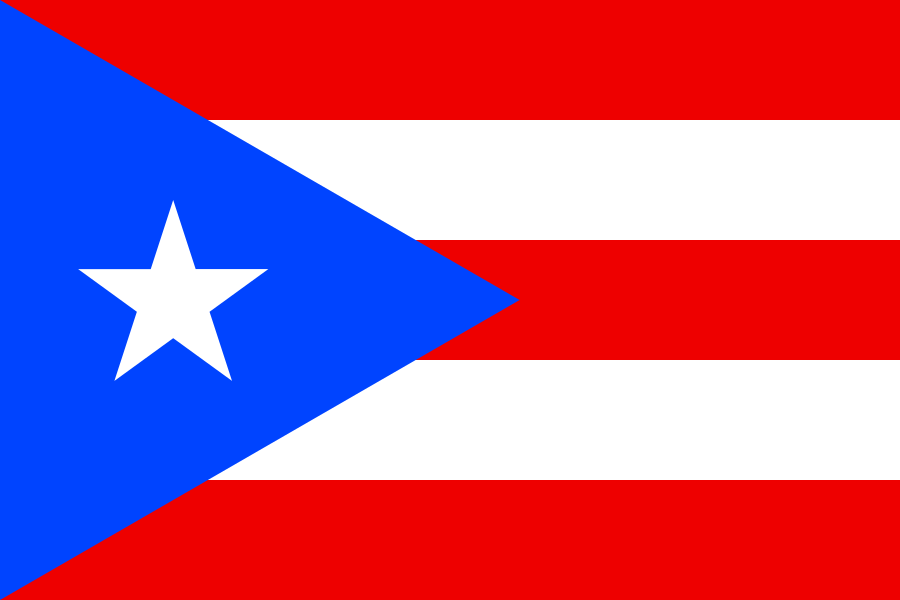
Puerto Rico Territory: What It Is and Why It Matters

Puerto Rico occupies a legally singular position within the American constitutional framework — a jurisdiction of 3.2 million U.S. citizens who hold no vote in federal elections and whose rights under the Constitution remain selectively applied by judicial doctrine. This page maps the structural reality of Puerto Rico's territorial status, identifies where legal and civic confusion concentrates, defines the hard limits of the territory's powers, and describes the federal regulatory apparatus that governs island affairs. Across more than 33 published reference pages — spanning historical statutes, Supreme Court doctrine, economic structure, and political status debates — this site provides the depth required for professional, academic, and civic engagement with Puerto Rico's governance landscape.


Core Moving Parts

Puerto Rico's status as an unincorporated territory derives from a specific constitutional provision and a chain of federal legislation and judicial decisions spanning more than 120 years. The Treaty of Paris 1898 transferred the island from Spain to the United States following the Spanish-American War, placing Puerto Rico under congressional authority without a defined path to statehood or independence. The Foraker Act of 1900 created the first civil government structure, establishing a civilian administration under federal oversight rather than military rule.

Citizenship followed in 1917 under the Jones Act, which collectively naturalized Puerto Ricans as U.S. citizens — though that statute simultaneously preserved congressional authority over the island's governance without granting full constitutional parity. The Puerto Rico Commonwealth Status, formally established in 1952 as Estado Libre Asociado, gave the island a local constitution and self-governance in internal matters while leaving federal supremacy intact in taxation, trade, immigration, and defense.

The operational structure of Puerto Rico's government rests on three interlocking elements:

  1. Federal statutory authority — Congress retains plenary power over the territory under Article IV, Section 3 of the U.S. Constitution (the Territorial Clause), meaning any local statute can be superseded by federal legislation.
  2. Local constitutional government — The Commonwealth Constitution of 1952 establishes a tripartite government with a legislature, executive branch, and judiciary that functions within the limits Congress sets.
  3. Hybrid fiscal oversight — Following the 2016 PROMESA legislation, a federally appointed Financial Oversight and Management Board holds authority over Puerto Rico's budget and debt restructuring, operating independently of elected island officials.

The Puerto Rico Government Authority provides structured reference coverage of the island's governmental institutions, including the legislature, executive agencies, and judicial bodies — an essential reference point for understanding how federal and local authority interact in practice.


Where the Public Gets Confused

The most persistent source of confusion involves the scope of U.S. citizenship rights for Puerto Ricans. Residents of Puerto Rico are U.S. citizens by birth but cannot vote in presidential elections, have no voting representation in Congress (only a non-voting Resident Commissioner in the House), and receive unequal access to federal benefit programs including Supplemental Security Income (SSI), which is not available to Puerto Rico residents despite being funded partly by their federal tax contributions.

A second widespread misunderstanding involves the term "commonwealth." The word implies a degree of sovereignty or association that the legal framework does not support. Puerto Rico's Estado Libre Asociado designation does not confer the autonomous status that "commonwealth" implies in international usage. Congressional authority remains total. Detailed analysis of this distinction is available on the Puerto Rico Commonwealth Status Explained page.

The statehood debate produces additional confusion because status referendums on the island do not carry binding legal force. Congress alone holds the authority to admit new states under Article IV, Section 3. Referendum results, including the 52.5% vote for statehood recorded in the 2012 plebiscite, reflect public preference but do not trigger any admission process.

Status referendums and their outcomes are catalogued in detail through the Puerto Rico Political Status History reference, which traces the chronological arc from 1898 to present congressional debate.


Boundaries and Exclusions

Puerto Rico's territorial status defines specific legal ceilings that local governance cannot exceed:

The frequently asked questions reference consolidates the most common inquiries about these limitations in a structured format for rapid professional reference.


The Regulatory Footprint

Federal regulatory jurisdiction over Puerto Rico is comprehensive. The island falls under the authority of federal agencies including the Environmental Protection Agency, the Food and Drug Administration, the Department of Labor, and the Internal Revenue Service. Puerto Rico residents pay Social Security and Medicare taxes at the same rates as mainland residents but access some federal programs at reduced or capped funding levels.

The Financial Oversight and Management Board, established under PROMESA in 2016, holds direct authority over fiscal plans, budgets, and debt restructuring — a governance structure with no parallel among the 50 states. The Board's existence reflects Puerto Rico's $74 billion debt load at the time of PROMESA's enactment (U.S. Congress, PROMESA, Pub. L. 114-187, 2016).

This site sits within the Authority Network America reference infrastructure, which organizes jurisdiction-specific public service and governance information across U.S. territories and states. The regulatory and legislative dimensions of Puerto Rico's status — from the Jones Act shipping constraints to federal funding disparities — are developed across the full reference library available through this domain.